 Historical places
Archaeological wonders of Pakistan
TourScope team · 25 November 2026 · 6 min read
Photo: Noman Bukhari / Unsplash
From Mohenjo-daro and Harappa to Taxila, Takht-i-Bahi and the Karakoram rock carvings: Pakistan's greatest archaeological sites and how to visit them.
Pakistan holds some of the oldest and most important archaeological sites on Earth, from the cities of the Indus Valley Civilisation, among the world's first, to the Buddhist monasteries of Gandhara and thousands of rock carvings along the old Silk Road. All six of Pakistan's UNESCO World Heritage Sites are archaeological or historic monuments. This guide covers the greatest sites, what makes each special and how to visit.
Key takeaways
- Pakistan has six UNESCO World Heritage Sites, all cultural: Mohenjo-daro, Taxila, Takht-i-Bahi, Makli, Lahore Fort and Shalimar Gardens, and Rohtas Fort.
- Taxila is the easiest major site to visit, under an hour from Islamabad.
- New discoveries keep coming. In 2026, new dating at Mohenjo-daro pushed back the age of its first city wall, and Sindh's first underwater survey found submerged walls in the Indus Delta.
- Visit between October and March. Sindh and Punjab are extremely hot in summer.
- Some sites are in areas with travel warnings for foreigners, including Swat, Mardan and Balochistan. Check before you go.
The Indus Valley Civilisation
Mohenjo-daro (near Larkana, Sindh)
The largest city of the Indus Valley Civilisation, and a UNESCO World Heritage Site since 1980. Around 4,500 years ago it had planned streets on a grid, brick houses, covered drains and the famous Great Bath. New radiocarbon dates reported by Dawn in March 2026 place its first city wall at about 2700 to 2600 BCE. A site museum shows seals, pottery and jewellery. Read our guide to Sindh's ancient sites.
Harappa (near Sahiwal, Punjab)
The site that gave the Harappan civilisation its name, first excavated in 1920 to 1921. Occupied for nearly two thousand years, it's easier to reach than Mohenjo-daro, just off the Lahore to Multan motorway. The site museum opened four new galleries in September 2025.
Kot Diji (Khairpur, Sindh)
Kot Diji gives its name to the Early Harappan phase, from about 3300 to 2600 BCE, before the great cities rose. Above it stands an 18th-century Talpur fort, added to UNESCO's Tentative List in 2026.
Mehrgarh and Rehman Dheri
Mehrgarh, near the Bolan Pass in Balochistan, is one of the oldest farming villages in South Asia, thousands of years older than Mohenjo-daro. Rehman Dheri, near Dera Ismail Khan, was a planned town from around 3300 BCE. Both lie in areas where Western governments advise against travel, so they're rarely visited by tourists.
Gandhara: the Buddhist heartland
Taxila (near Islamabad)
A UNESCO World Heritage Site and, for centuries, a great centre of Buddhist learning. Visit the ruined city of Sirkap, the Dharmarajika stupa and the hilltop monastery of Jaulian, then the excellent Taxila Museum. In April 2026, Punjab began a three-year project to preserve the sites and add new museum galleries. Taxila is an easy half-day trip from Islamabad.
Takht-i-Bahi (near Mardan)
A Buddhist monastery spread across a hilltop, founded around the 1st century CE and used until about the 7th century. Its courtyards, stupas and monks' cells are remarkably complete. It's a UNESCO World Heritage Site together with the nearby town remains at Sahr-i-Bahlol.
Swat's Buddhist sites
Swat was a major Buddhist centre, with hundreds of stupas and monasteries. Butkara I, in Mingora, is still being excavated: in 2026 the Italian Archaeological Mission found a Mauryan-period silver coin. The Jahanabad Buddha, a seated Buddha carved into a cliff, was blown up by militants in 2007 and restored by Italian experts by 2016. The Swat Museum in Saidu Sharif reopened in 2014.
Shah Allah Ditta caves (Islamabad)
On the edge of the Margalla Hills, these caves were used by Buddhist monks and still carry traces of old paintings. A preservation project began in November 2026. An easy outing from Islamabad.
Rock art of the Silk Road
The Karakoram Highway petroglyphs
Along the Indus around Chilas, Thalpan and Shatial, boulders carry an estimated 37,000 rock carvings and 3,600 inscriptions, left by hunters, Buddhist pilgrims and Silk Road traders over thousands of years. At Shatial there are hundreds of inscriptions by Sogdian merchants from Central Asia. Much of this area will be flooded by the Diamer-Bhasha dam, so see them while you can. Note that the UK advises against travel on the stretch of the Karakoram Highway south of Chilas.
The Sacred Rock of Hunza
Near Ganish, below Karimabad, a rock face known as Haldeikish carries inscriptions in several ancient scripts, including Kharosthi, Brahmi, Sogdian and Chinese, plus carvings of ibex. Easily combined with a visit to Hunza.
The Manthal Buddha Rock (Skardu)
A large granite boulder on the edge of Skardu carved with a Buddha and smaller figures, usually dated to around the 8th century. See our Skardu guide.
Forts, temples and tombs
Makli Necropolis (Thatta, Sindh)
One of the largest cemeteries in the world, with hundreds of thousands of graves and richly carved stone and glazed-tile tombs of the rulers of Thatta. A UNESCO World Heritage Site since 1981. The 2022 floods caused damage, and conservation work is continuing.
Ranikot Fort (Jamshoro, Sindh)
Often called the "Great Wall of Sindh", its walls snake for kilometres across barren hills. Its origins are still debated. Parts collapsed in the 2022 floods.
Banbhore and Chaukhandi (near Karachi)
Banbhore is an ancient port city that many scholars identify with Debal, where the Arab conquest of Sindh began in 712 CE. Excavations continue, and in 2026 Sindh's first underwater survey found submerged walls in the Indus Delta. The Chaukhandi tombs, in Karachi, are sandstone graves carved with remarkable geometric patterns.
Rohtas Fort (near Jhelum)
A massive 16th-century fortress built by Sher Shah Suri, with walls about 4 kilometres long and huge gateways. A UNESCO World Heritage Site since 1997, and an easy stop on the road between Islamabad and Lahore. See our Salt Range guide.
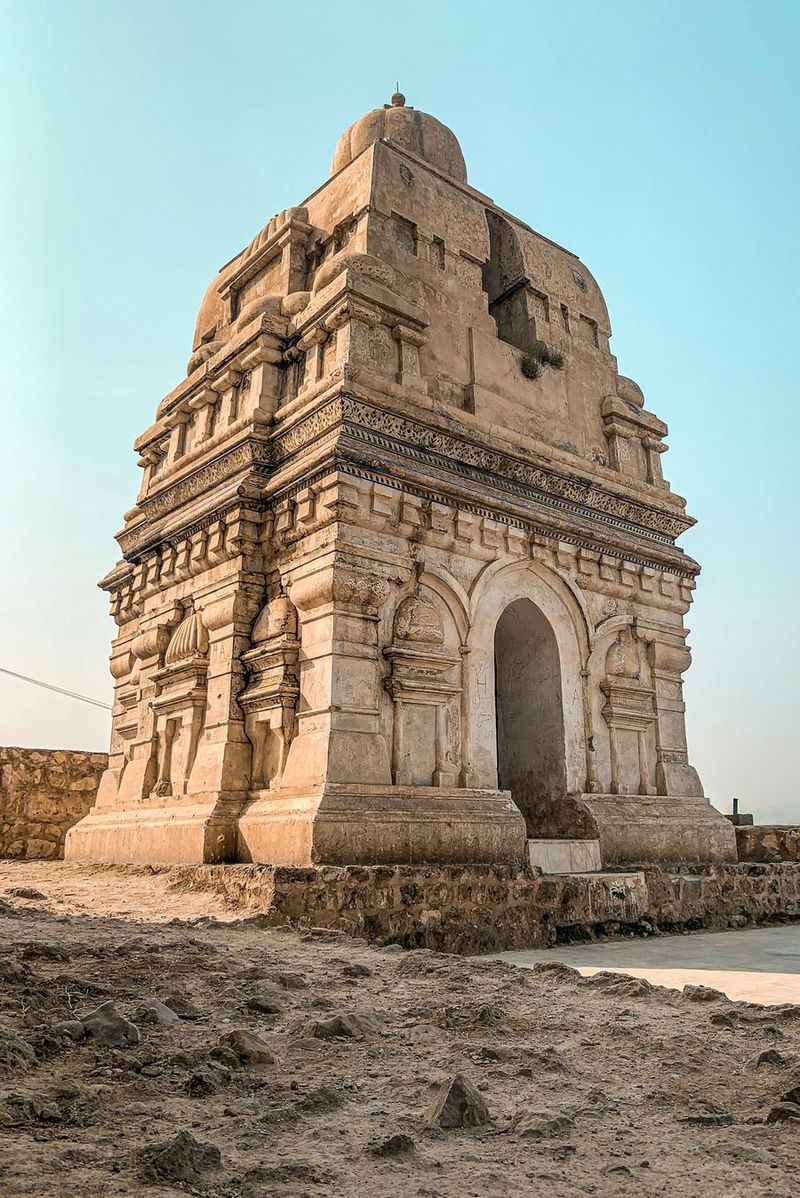
Katas Raj temples (Chakwal)
A complex of Hindu temples around a sacred pool, dating back more than a thousand years and still visited by pilgrims from India. Combine it with the Khewra Salt Mine.
Lahore Fort and Shalimar Gardens
The Mughal fort and gardens of Lahore, a UNESCO World Heritage Site since 1981. In 2026 restoration of the fort's Picture Wall, covered in tile mosaics, was completed. Read our Lahore heritage guide.
Planning your visit
- Best season: October to March. Summer heat in Sindh and Punjab can pass 45°C.
- Hire a guide at the bigger sites; the stories behind the ruins are what bring them to life.
- Check the travel advice before visiting sites in Swat, Mardan, Dera Ismail Khan or Balochistan. See Is Pakistan safe for tourists?
- Use a tour company for multi-site trips in Sindh, where distances are long. Compare companies that run tours to Sindh and Punjab, or let us match you with a tour company.
Frequently asked questions
What are the UNESCO World Heritage Sites in Pakistan?
Six cultural sites: Mohenjo-daro (1980), Taxila (1980), Takht-i-Bahi and Sahr-i-Bahlol (1980), the Makli monuments at Thatta (1981), Lahore Fort and Shalimar Gardens (1981), and Rohtas Fort (1997).
What is the oldest archaeological site in Pakistan?
Mehrgarh, in Balochistan, is one of the oldest Neolithic farming settlements in South Asia, with its earliest layers dating back thousands of years before the Indus cities.
Which archaeological site is closest to Islamabad?
Taxila, under an hour's drive away. The Shah Allah Ditta caves are on the edge of Islamabad itself.
Is Mohenjo-daro worth visiting?
Yes, it's one of the world's great ancient cities. It's a long journey from Karachi or via Sukkur, so plan at least a full day, and go in the cooler months.